


Melody's Piano Adventure
Mobile Music Academy have just released the E-BOOK version of Melody's Piano Adventure. Here is everything you need to know about this brand new narrative-based approach to learning the piano!
#NarrativeLearning #PianoPedagogy #ColourCoded #Melody #RainbowAdventure

Synopsis
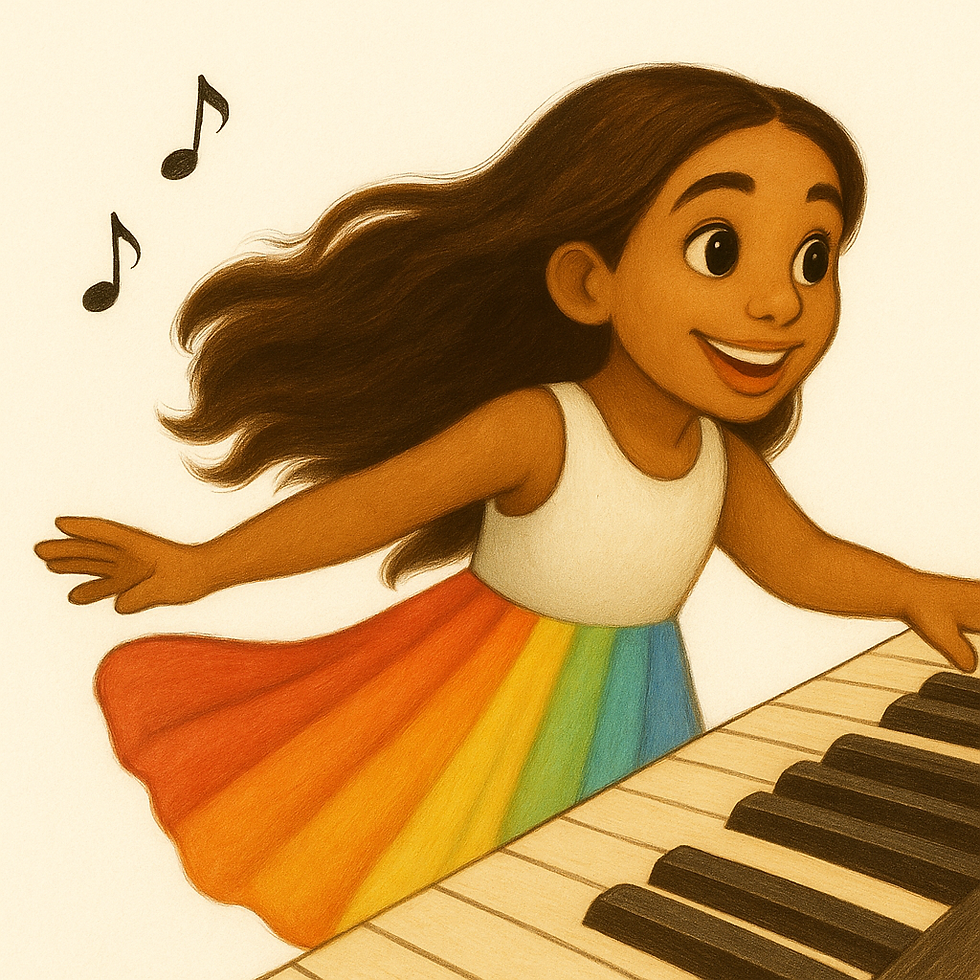
A magical journey awaits a sleeping girl named Melody. In her dreams, she sees a rainbow filled with friendly animals who greet her with cheerful waves and colorful tones. Suddenly, a musical rooster crows, “Cock-a-doodle-doo!” waking her up and guiding her to the piano.
Chickovsky shows Melody how to find her friends using a major scale and explains that each pitch corresponds to one of them. With her playful pets, Cleo the cat and Dexter the dog, by her side, Melody sets off on an adventure, following the rooster toward the forest gate.
Colour and imagination come alive as the Stave Gate is opened and the journey begins. Each animal they meet sings an introduction song that reflects their character. A helpful golden orb spider spins wise words to explain musical terms.
Along the path, they meet an elephant who toots like a trumpet, a frog who hops in perfect rhythm, and a gentle giraffe who rescues Dexter. Everyone discovers that sound, colour, and friendship work together in harmony to make learning music fun.
Storytelling, colour-coded notation, and songs with silly sounds work together to engage the reader's imagination as they journey through a musical world of adventure.

Color-Coded Notation
Each pitch is represented by a unique animal character. The color-coded system helps young beginners instantly recognise pitches by connecting each colour to a key. We include a set of specially crafted stickers so you and your piano can enjoy the rainbow magic.
C - Cleo the Red Cat
D - Dexter the Orange Dog
E - Erica the Yellow Elephant
F - Freddy the Green Frog
G - Gerry the Blue Giraffe
A - Arthur the Navy Blue Ant
B - Bella the Pink Bee

Why It Works
Color-coding uses visual memory and pattern recognition to create a quick connection between auditory and visual information.
Immediate visual and pitch recognition: Students see a color and associate it with
a tone.
Improved engagement: Bright visuals make learning more playful and less intimidating.
Cross-modal reinforcement: Combines sight, sound, and touch—especially effective for kinesthetic and visual learners.
Accessiblilty for early childhood and SEND (Special Education Needs & Disabilities)

Narrative-Based Learning
Children learn well when immersed in a story. Melody’s Piano Adventure blends musical concepts with a rich, character-driven tale. Instead of memorising notes or scales, children experience music through characters, colours, and songs associated with each letter of the music alphabet.
As the children step deeper into Melody’s world, they begin to internalise musical ideas and technique naturally by associating rhythm with movement, pitch with colour, and harmony with friendship.
Through Melody’s kindness and curiosity, children understand teamwork, problem-solving, and perseverance. This wholistic and wholesome approach has immense benefits for developing young minds.
We invite learners into a world where music and storytelling combine to create an integrated platform for creative thinking. Every page of Melody’s Piano Adventure presents something new and encourages the learner to take the initiative in their own musical journey.

Gamification
Melody’s Piano Adventure uses the principles of gamification to make learning a more playful and rewarding experienece. Each scene in the story is beset with challenges which can be overcome with the help of Cloud Clues, Quick Quill Notes, and Web Buddies (Important Information). Children are invited to “play along,” echoing rhythms, spotting colours, and solving musical puzzles
Gamification allows abstract musical ideas to be tangible and fun. Examples include: when Cleo scratches in “crotchets and quavers,” or “sharpens her claws from C to C#” , when Dexter sniffs out the scale, or when the friends play the “Game of Smiles” to understand intervals. Music theory is presented as an interactive activity rather than sterile information.
Curiosity and active participation are vital to meaningful learning and long-term retention. Progression and achievement unlock this potential. Each rainbow friend introduces a new layer of challenge, inspiring children to keep exploring. As their understanding deepens, so does their excitement to continue the adventure.


Comments